What size aircon do I need? A simple HP guide
Aircon HP by room size: 1 HP for 10–15 sqm, 1.5 HP for 15–20 sqm, 2 HP for 20–30 sqm, plus when to size up for sun, roof heat or more people.
For a typical Philippine bedroom of 10–15 sqm, a 1 HP aircon is the right size. As a rule, plan for about 600 BTU/hr per square meter of floor area. Then go one size up if the room gets afternoon sun, sits under the roof, has a high ceiling or is used by three or more people.
Aircons here are sold by horsepower (HP), but the label lists cooling capacity in BTU/hr or kJ/h. Two units both sold as "1 HP" can have different capacities, so the label number is the one to compare.
Quick reference
| Room area | Suggested size | Typical capacity | Typical room |
|---|---|---|---|
| Up to 10 sqm | 0.5–0.75 HP | ≈ 5,000–6,500 BTU/hr | Small bedroom, studio nook, home office |
| 10–15 sqm | 1 HP | ≈ 9,000 BTU/hr | Standard bedroom, condo studio |
| 15–20 sqm | 1.5 HP | ≈ 12,500 BTU/hr | Master bedroom, small living room |
| 20–30 sqm | 2 HP | ≈ 18,000 BTU/hr | Living room, 1-bedroom condo living and dining |
| 30–40 sqm | 2.5 HP | ≈ 24,000 BTU/hr | Open-plan living and dining area |
For 40–45 sqm, a 3 HP unit (about 27,000 BTU/hr) fits. Above that, two smaller units placed at opposite ends usually cool more evenly than one big unit.
How to work out your size
- Measure the room. Multiply length by width in meters. A 3.5 m × 4 m bedroom is 14 sqm.
- Multiply by 600. 14 sqm × 600 = 8,400 BTU/hr of cooling needed.
- Pick the next standard size up. 8,400 BTU/hr fits within a 1 HP unit (about 9,000 BTU/hr).
- Check the conditions below. If any apply, move up one size. The same 14 sqm room under a hot roof becomes 1.5 HP.
- Read the label. Compare the BTU/hr or kJ/h figure, not only the HP printed on the box.
Count only the space the aircon has to cool. If the room opens to a hallway or kitchen with no door, add that area too. Our aircon size calculator does these steps for you and adds the adjustments.
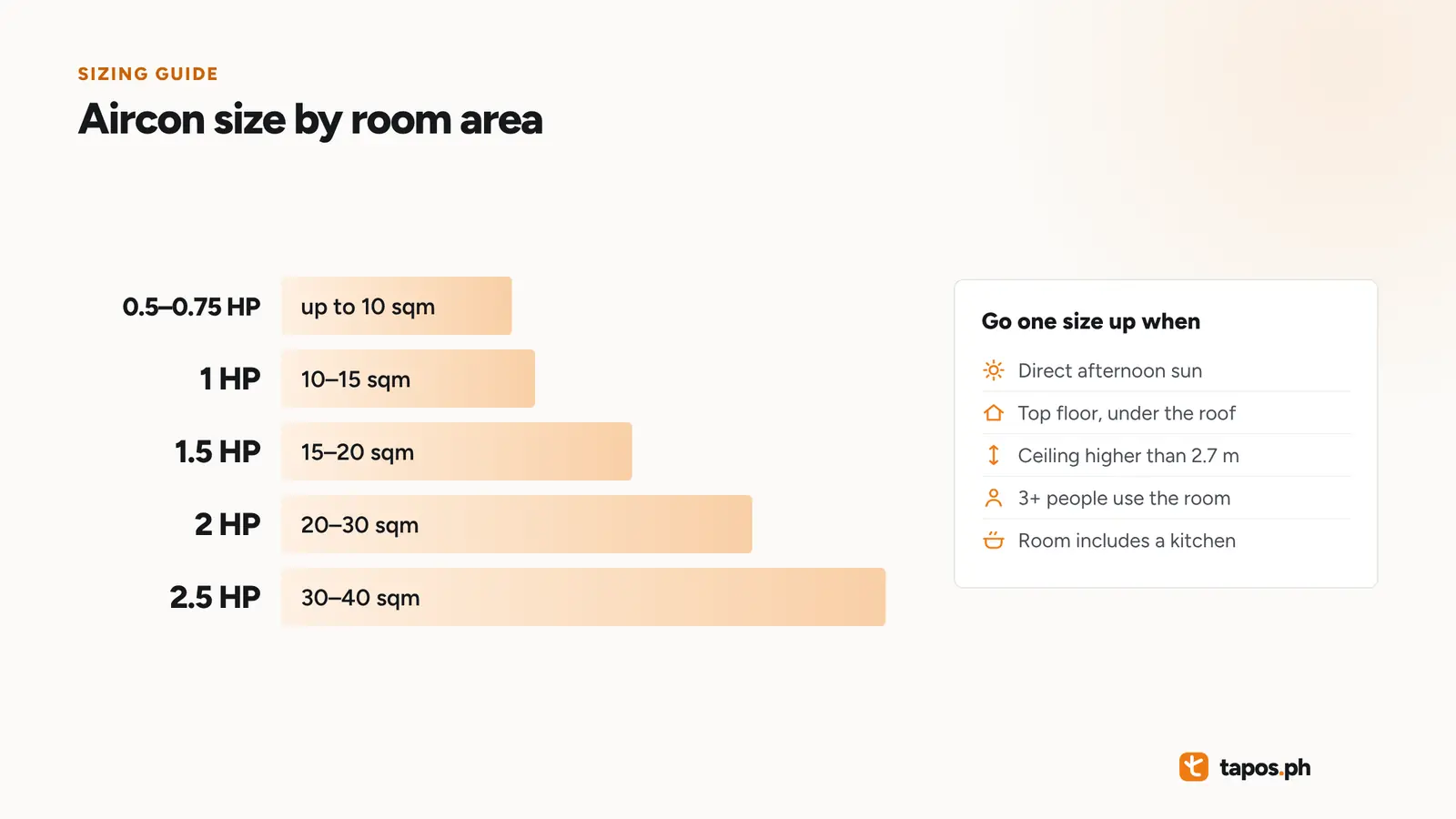
Go one size up when
- Direct afternoon sun. West-facing walls and large windows heat up from about 1 p.m. until sunset, exactly when you need cooling most.
- Top floor, under the roof. A metal roof in summer turns the ceiling into a heater. Rooms in attics and top-floor condo units need more capacity.
- Ceiling higher than 2.7 m. More air volume to cool than the floor area suggests. This is common in older houses and lofts.
- Three or more people use the room. Each person adds body heat. A family bedroom or a home office with several people runs warmer.
- The room includes a kitchen. Cooking adds a lot of heat, so open-plan condos with a kitchen need the larger size.
If two or more of these apply, do not guess. Use the calculator, because the extra load can add up to more than one size in a bigger room.
Why not just buy bigger?
A bigger unit costs more to buy and install, and it does not always feel better. An oversized non-inverter unit cools the air fast, reaches the set temperature and switches off before it has removed the moisture. In Philippine humidity that leaves the room cold but sticky, and the constant on-off cycling wears the compressor.
An undersized unit has the opposite problem. It runs at full power all afternoon, never quite reaches the set temperature, and pushes up your Meralco or electric cooperative bill. It also wears out faster.
Inverter units slow down instead of switching off, so they handle a slightly larger size better and use less power once the room is cool. Sizing still matters, though: an inverter that is too small runs at full speed all the time and loses its savings. To estimate running costs before you buy, try the aircon electricity cost calculator with the rate per kWh from your latest bill.
Window or split type?
- Window type: lower purchase and installation cost, one box in a wall opening. Louder, and it needs a sleeve or opening of the right size. Good for single bedrooms in houses.
- Split type: quieter indoors, more placement options, and inverter models are widely available. It needs an outdoor unit with space around it and a pipe run between the two units. Usual choice for living rooms and condos.
Many condos do not allow window units or new wall openings, and they set rules on where outdoor units can go. Ask the building admin before you buy.
Before you buy and install
- Confirm the size with the steps above, then write down the BTU/hr or kJ/h you need.
- Check the power supply. Larger units often need a dedicated circuit and outlet. A licensed electrician should check this. Do not run an aircon on an extension cord.
- Check condo or subdivision rules. Many buildings require a work permit, set installation hours and may ask for the installer's details in advance.
- Plan the outdoor unit spot. It needs airflow, shade if possible, and safe access for future cleaning.
- Budget for installation. Typical installation costs ₱2,500–₱8,000 per unit. Price depends on the pipe length, wall type, mounting height and whether brackets or extra wiring are needed.
Ask the aircon technician to confirm the size after seeing the room. A good installer will tell you if your room needs a different HP than you planned. See what is included in aircon installation.
When you know the size you need, you can describe the room once on tapos and request up to 5 free quotes from aircon technicians in your area to compare prices and scope.
Frequently asked questions
What size aircon do I need for a 3 x 4 meter room?
A 3 x 4 m room is 12 sqm, which needs about 7,200 BTU/hr. A 1 HP unit (about 9,000 BTU/hr) fits, or 1.5 HP if the room gets afternoon sun or is under the roof.
Can one aircon cool two rooms?
Not well. Cold air does not travel reliably through doors and hallways, so the far room stays warm while the near room overcools. Separate units, or a multi-split system with one indoor unit per room, work better.
Is 1.5 HP too big for a small bedroom?
For a shaded bedroom under 15 sqm, usually yes, especially with a non-inverter unit that will cycle on and off and leave the room humid. It makes sense only if the room has strong afternoon sun, a hot roof above or several people sleeping in it.
What is the difference between BTU/hr and kJ/h on the label?
Both measure cooling capacity in different units. 1 kJ/h is about 0.95 BTU/hr, so a 9,500 kJ/h unit delivers roughly 9,000 BTU/hr.